
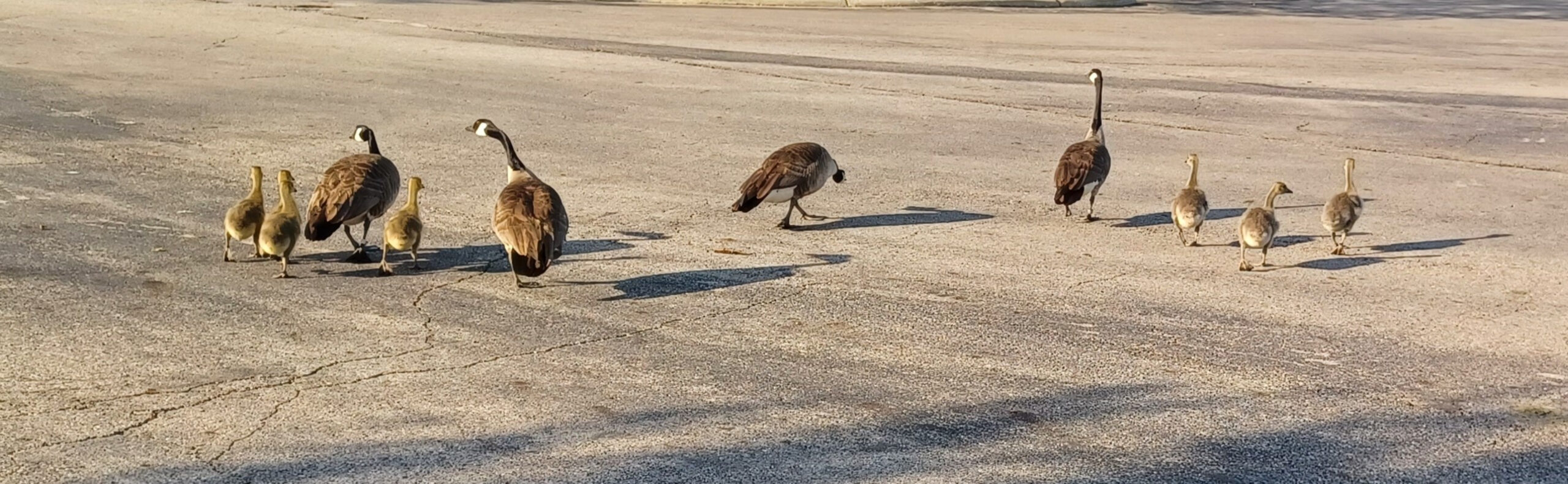
Learn about the ultimate defenders of Canadian geese babies and of the nest.
When you think of an individual who expertly defends his family against intruders, what sort of physical description might first come to mind? Someone with big muscles, a thick neck, and a chiseled chin? Sure, but how about a feathery creature with stringy muscles, a long, skinny neck, and no chin whatsoever? No? Then, indeed, you’ve never been near a Canadian goose nest.
Years ago, I witnessed an unsuspecting gentleman encounter the fierce protective nature of a male Canadian goose guarding a nest. While he stood patiently waiting at a bus stop, the goose crept up from behind, ready to scare him out of his socks. Appearing to have sensed its presence, the man turned around and literally jumped back in surprise.
Hissing menacingly, with its head low to the ground, the advancing goose spread its wings and beat the air. Fortunately, the bus arrived at that moment, and with a look of terror, the man quickly stumbled aboard. Soon, his face emerged at one of the windows, eyes big as saucers, still watching the goose as he rode away.
Among Canadian geese, technically termed Canada geese, there exists a strong bond. Couples are generally inherently monogamous, staying together until parted by death, although extra-pair copulations have been documented.
In their second or third year of life, the young males and females pair up and begin to look for a good location to make a nest. A nesting place is chosen from a broad spectrum of possible sites. These include secluded areas beneath trees, shrubs, and various kinds of vegetation, especially those near water.
Other nests are hidden by a variety of man-made formations. Those most commonly used are flat roofs. In fact, on several occasions, Canadian geese have built a nest on the rooftop of the one-story building where I work. One afternoon, Papa Goose came down and patrolled the ground directly below the roof edge where Mama Goose set upon her nest. Like a sentry, he paced back and forth, eyeing every passerby with grave suspicion. Behind him was the front door, so confrontation was bound to happen.
Unsurprisingly, he was soon faced with a potential threat in the form of my co-worker, Ian. Although he was noticeably leery of the goose, Ian was determined to walk right past this unfriendly interloper. Papa Goose was going to have none of this and slinked aggressively toward Ian with the same hissing, his head low to the ground, and his wings outspread.
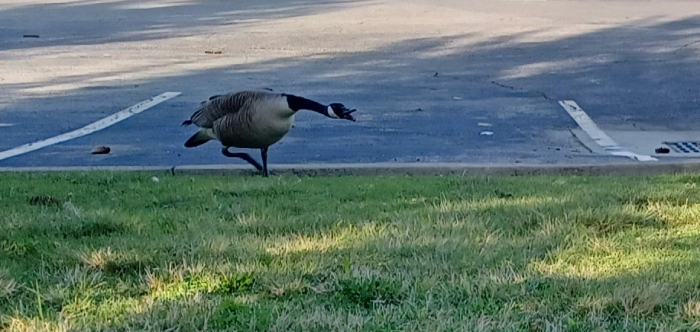
With sweat forming on his brow and the color draining away from his face, Ian tried to sidestep the disturbing creature on his way to the door. Naturally, this defiance sent Papa Goose into a frenzy, and he began whacking Ian on either side with his wings. “Get away from me, you goose!” Ian screamed in terror as he held up one foot to fend off his attacker and hopped along with the other one. Slowly inching his way, Ian finally reached the door and slipped inside, looking frazzled and barely able to speak. Once again, I had witnessed the fierce defensive measures of the Canadian goose.
This aggressive protection doesn’t end with the hatching of their offspring. Quite the opposite, male and female Canadian geese protect their hatched goslings fiercely for up to three months before showing any leniency. Also, several broods may come together and form what are known as ”gang broods.” Just a few adults may defend these gosling conglomerates, which may number as high as 100. Occasionally, these broods even display intense aggression toward goslings who are outside the gang.
I observed this behavior while I was driving one day. I had just stopped at a traffic light, when I noticed three Canadian geese crossing a large intersection in front of me. Two adults strutted proudly, heads held high, while one small gosling followed closely on their heels. Having quite naturally assumed that it was their offspring, I was shocked when the pair suddenly turned and chased the little one away violently. Without care, the adults turned and resumed their walk, only to discover the little tyke scurrying right up behind them a second time. Again, the adults lowered their heads and threateningly chased it in the other direction. This cycle repeated once more before the youngster was finally scared away permanently.
Now, the poor gosling was helpless and alone, standing motionless on the road. It was certainly in danger, so I decided that it was time for a rescue mission. Incredibly, no vehicles had passed by during this episode, and still, none were anywhere in sight as I jumped out of mine. I noticed a large flock of Canadian geese foraging a short distance from one side of the road, and I planned to herd the little one toward them. However, it took one look at me and instantly ran away.
Making a wide circle, I was able to head it off and drive it in their general direction. However, when it reached the side of the road, it discovered that the curb was too high. The gosling tried with all its might to jump over the barrier, but it was far too small to do so successfully. Its tiny legs were a blur of activity as it once again raced around in every direction with me tagging along behind. Every now and again, it attempted yet another leap over the curb, always with the same result. Eventually, I managed to scoop my hands underneath and gave it a boost up and over the obstacle. The gosling didn’t miss a step and kept right on running in the direction of the nearby flock, where it hopefully reunited with its family.
No, Canadian geese certainly don’t look particularly strong or aggressive. They fear outsiders and commonly move away when approached, but don’t let that fool you. They’ll be ready to rumble if you go anywhere near their young, hatched or unhatched. Just ask Ian!
Resources
Richard-Craven, M. (2022, Dec. 14). 10 Fun Facts about the Canada Goose. Retrieved from https://www.audubon.org/ news/10-fun-facts-about-canada- goose
Canada Geese Management. Retrieved from https://www.in.gov/dnr/fish-and-wildlife/hunting-and-trapping/canada- geese-management
Mark M. Hall lives with his wife, their three daughters, and numerous pets on a four-acre slice of paradise in rural Ohio. Mark is a veteran small-scale chicken farmer and an avid observer of nature. As a freelance writer, he endeavors to share his life experiences a manner that is both informative and entertaining.
Originally published in the December 2024/January 2025 issue of Backyard Poultry and regularly vetted for accuracy.
…
https://backyardpoultry.iamcountryside.com/poultry-101/geese/defending-canadian-geese-babies-zm0z25djzols/
backyardpoultry.iamcountryside.com
Feed Name : Backyard Poultry
Geese,geese,goslings
hashtags : #Defending #Canadian #Geese #Babies #Backyard #Poultry










Leave A Comment