

By Bruce and Elaine Ingram
When the Topic is chicken “clothes,” the fashionable young hen (or the matronly older female as well) needs only to consider two items of adornment this year: leg bands and aprons. Here’s why you should consider having your birds dress in style this year.
Leg Bands
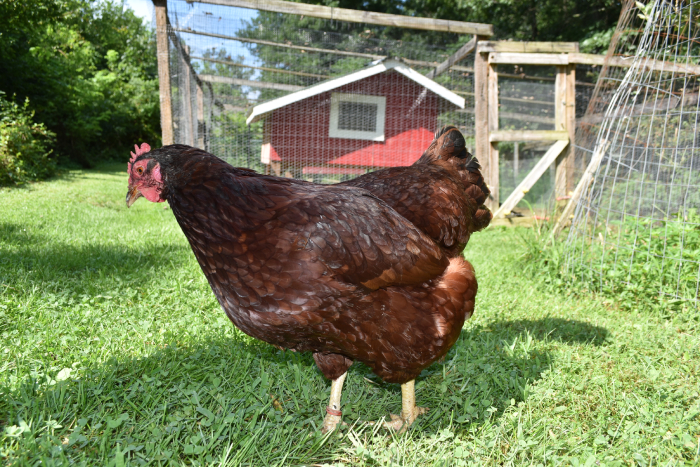
Three reasons exist concerning why we should position leg bands on our chooks: to determine which ones are our best layers, to keep up with the ages of birds, and to view our birds as individuals. For example, currently, in one of our two runs, four heritage Rhode Island Red hens reside: Five-year-old mother hen, Charlotte, and her three sevenmonth-old pullets (with the color of their leg bands in parentheses): Winter (black) Spring (green) and Autumn (yellow).
Because of her advanced age, size, and spurs (which older hens sometimes develop), Charlotte no longer wears a band like she did when she was young. Her three offspring all sport that classic mahogany brick red hue that purebred Reds possess, so they truly do all look alike in size and color. However, the bands have already allowed me to perceive the differences between the trio. The run’s fifth chicken, Boots, doesn’t sport a leg band.
Winter flaunts a particularly nasty disposition, hence her name and ebony band. She has charged me multiple times, implementing sneak attacks against my legs when I turned my back. The malcontent has also pecked me several times when I kneeled down to fill the feeder. It’s almost as if she’s channeling the “wanna-be cockerel” bubbling up inside her.
Yet, Winter’s leg band has also allowed me to determine that she’s at the bottom of the pecking order among the female quartet. Obviously, Charlotte rules the proverbial and literal roost, positioning herself on the section nearest the ventilation window … prime real estate. Boots sleeps next to her, and Spring and Autumn are perched a little distance away. Although plenty of room exists on the roost, Winter clearly isn’t allowed to spend the night there. She either sleeps in the straw (Oh, the humiliation!) or rests her feet on a nesting box rim.
Besides learning more about your chickens as individuals, leg bands offer several practical applications: keeping up with our birds’ ages and egg-laying abilities. From years of raising heritage Reds, I’ve learned that their egg-laying abilities decrease dramatically after age three. So, the fall of year three, Elaine and I typically butcher hens if they’ve never gone broody, are mediocre layers, or have disagreeable temperaments. (Are you listening, Winter?)
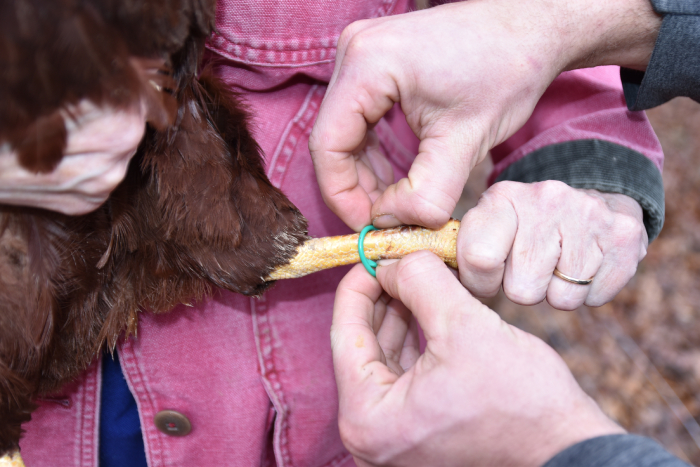
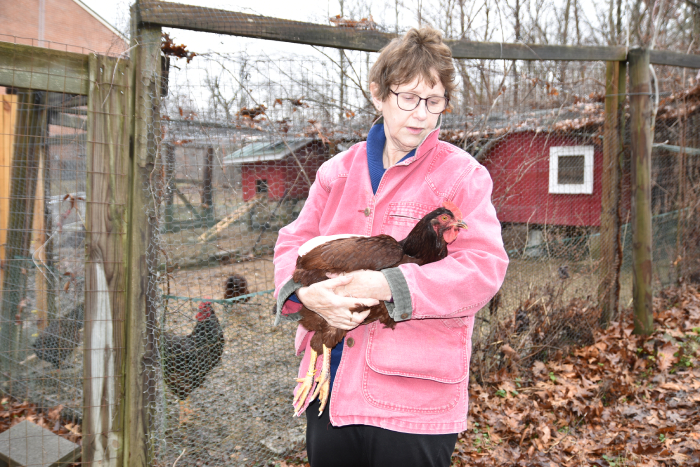
With leg bands, it’s extremely easy to learn which chicken is the broody one. And every summer when I’m not teaching high school English, I devote three or four days to hourly checking nesting boxes to observe who’s regularly laying. And if you suspect one of your birds of being an egg eater, those suspicions can hopefully be confirmed thanks to leg bands identifying the sole perpetrator. Finally, positioning a leg band on a hen is better if two people are involved. I typically hold a hen tight to my chest while Elaine slips on the “jewelry.”
Aprons
Whereas Bruce is in charge of keeping up with the leg bands, aprons are my job. I’ve made chicken aprons (also called saddles) in the past and have also ordered them from supply sites. I see them frequently in local farm supply stores as well.
The first ones I made were a single layer of woven cotton fabric with elastic sewn on to go around the wings and hold the saddle in place. I also put a loop to go over the chicken’s head to help anchor the apron. But after buying one, I realized that I needed to make a couple of changes, one of which wasn’t to create a neck loop. With that loop gone, the apron didn’t upset a chicken as much when we were affixing a saddle.
First of all, the apron works better if it’s made of two layers of woven fabric, each approximately 7-1/2-by9-inches. Denim or fabric of that weight works well, as does twill or cotton duck. I searched online for a pattern that I could draw and modify for my chickens.
When I sewed the apron, I used 12 inches of 1/4-inch elastic. I permanently attached it to the sides (in what would be the underarm areas of a human apron) but encased it in a fold of fabric on the top of the apron, where it crossed over the chicken’s body behind its neck.
This allows the elastic to slide, making a large loop to go over the wing when putting the apron on a chicken. Then the elastic can slide again to fit over the other wing. Once both wings are in the apron loops, Bruce and I center the apron on the back of the chicken, and she’s ready to rejoin the flock.
Two last points need to be made. Obviously, aprons are beneficial for hens that have been “over-mated” by overly amorous roosters and especially feisty, young cockerels. A hen without her back feathers is more vulnerable to afflictions and being bullied by other hens. Second, most hens become used to their “new outfit” in a few hours. However, we’ve had several hens hysterically react to this garb and never accept it, careening around the coop and complaining constantly … which causes the entire flock to become agitated. Then, for the sake of your sanity — and your birds — it’s best to discard the apron.
Classic clothing never goes out of style. So this year, consider adorning your hens with the latest in fashion: leg bands and aprons.
Bruce and Elaine Ingram are authors of Living the Locavore Lifestyle, a book on hunting, fishing, and gathering for food, including recipes. For more information, contact them at Bruce IngramOutdoors@gmail.com.
Originally published in the December 2024/January 2025 issue of Backyard Poultry and regularly vetted for accuracy.
…
backyardpoultry.iamcountryside.com
Feed Name : Backyard Poultry
Chickens 101,hen apron
hashtags : #WellDressed #Hens #Backyard #Poultry










Leave A Comment