

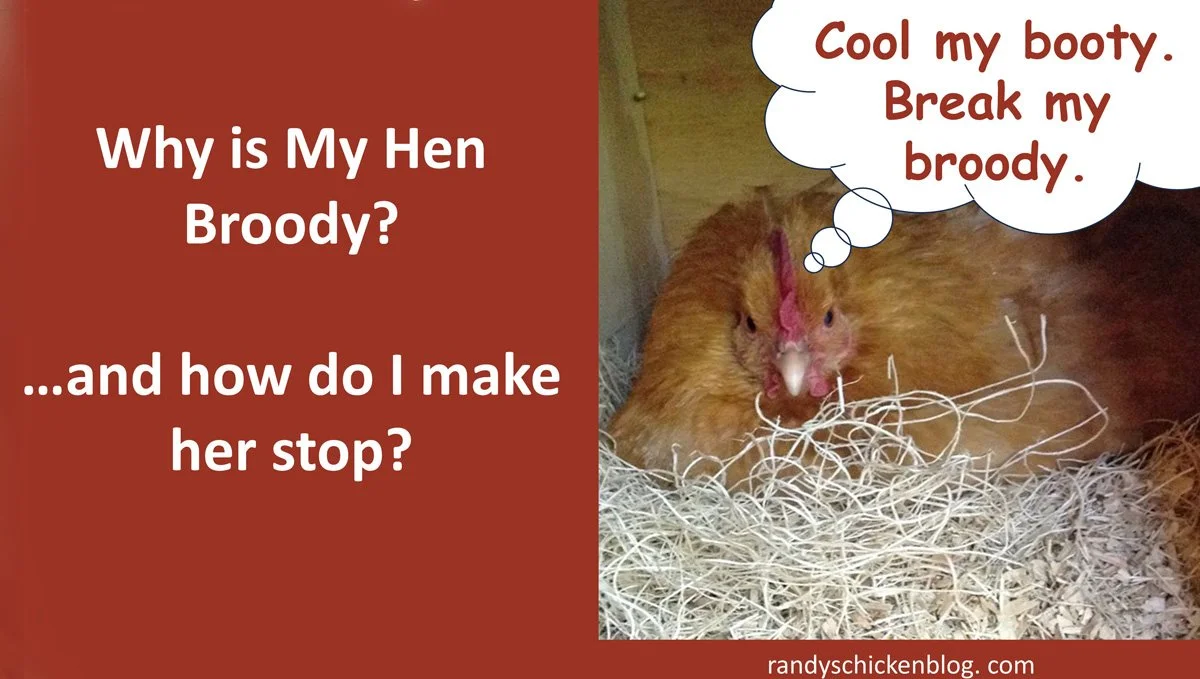
Why does a hen decide it’s time to go broody? It isn’t a random whim. Specific conditions around her help trigger that change.
A quiet, cozy nest
Hens prefer to brood in dim, comfortable spaces tucked away from the hurly-burly of the flock. If they can build a snug nest in a dark, quiet spot, they’ve found the brooding serenity they’re looking for. I understand the appeal—I find dark, quiet nooks pretty comforting myself. Doesn’t everybody?
Warm weather and longer days
Spring and early summer, with their rising temperatures and extended daylight encourage broodiness. During these seasons, hens are far more likely to commit themselves to brooding a clutch of eggs.
Other broody hens
Broodiness can be contagious. When one hen starts sitting, others may follow. Buffy reasons, “If Rosie, Fluffy, and Henrietta are all brooding eggs, that must be the cool thing to do. I’d better jump on the egg wagon!” It’s another example herd mentality—or, in this case, flock mentality.
An accumulation of eggs
All birds tend to brood their eggs after a peak laying period and the accumulation of a sufficient number of eggs. What does a hen consider “sufficient”? Some sources mention a dozen eggs. Studies have shown that chickens have the ability to count. So, do they keep track of their eggs? Is Buffy putting little hatch marks on the side of her nest box every time she lays an egg so she can start to brood when she reaches that magic number? Nope. Buffy is not that regimented. Instead of a precise number, the limit is probably related to how many eggs she can successfully cover and keep warm. For an average hen, that happens to be roughly a dozen eggs.
Also, while it’s an important trigger, egg accumulation is not a strict requirement. Hens whose eggs are collected daily will still morosely brood an empty nest.
Hens have three glands that work together in an intricate system of hormonal signals and feedback loops: the hypothalamus and pituitary gland in their brains, and the gonads (ovaries)—located farther south in their bodies. Sometimes these glands stimulate one another; sometimes they shut one another down. This hormonal conversation controls a hen’s broodiness.
That, of course, is a gross oversimplification. The hypothalamic–pituitary–gonadal (HPG) axis does a whole lot more than regulate broodiness. It controls egg laying, sexual development and maturation, behavior, physiology, and even immune function. And this system isn’t unique to chickens. The HPG axis plays a central role in all birds and in all other vertebrates—reptiles, fish, mammals—and humans. And in both males and females.
To understand how a hen stops laying and becomes broody, it helps to first understand how the HPG Axis starts egg laying. Let’s begin with that.
The HPG Axis – Turning on the Egg Faucet
1. Light initiates the process: Environmental cues—especially increasing daylight —activate egg production. Mammals rely on their eyes to detect light. Chickens and other birds, in addition to their eyes, have light-sensitive cells on their pineal gland, located near the surface of their brains. Light penetrates a hen’s skull and stimulates these receptors, causing her pineal gland to reduce production of melatonin.
2. Melatonin drops; GnRH rises: Reduced melatonin triggers the hen’s hypothalamus to secrete gonadotropin-releasing hormone (GnRH).
3. The pituitary joins in: GnRH travels from the hen’s hypothalamus through a network of blood vessels at the base of her brain to her anterior pituitary gland and triggers it to secrete follicle-stimulating hormone (FSH) and luteinizing hormone (LH).
4. The ovaries respond: FSH and LH travel through the hen’s bloodstream to her ovaries and prompt an egg follicle to develop and mature—an egg yolk begins to form within the follicle. As the follicle matures, it begins to secrete estradiol.
5. The hen’s body prepares an egg: Estradiol signals the hen’s liver to produce yolk proteins and stimulates her oviduct to prepare for forming egg white and shell.
6. The mature follicle sends a signal: When the follicle reaches full maturity, it releases a surge of progesterone. This triggers the hen’s pituitary to release a large surge of LH.
7. Ovulation occurs: The LH surge causes the mature follicle to release its yolk into the hen’s oviduct. As the yolk travels down her oviduct, egg white is added, and then the shell.
8. And finally, the hen lays an egg: This process repeats continuously almost daily.
The HPG Axis – Turning off the Egg Faucet
Broodiness and turning off egg production involves a different set of feedbacks with many of the same hormones within the same HPG system.
1. The environment triggers the hypothalamus: Warm weather, longer hours of daylight, and all the other environmental factors I listed previously trigger the hen’s hypothalamus to release vasoactive intestinal peptide (VIP).
2. Prolactin rises: VIP signals the hen’s anterior pituitary gland to produce prolactin—the same hormone that stimulates milk production in mammals.
3. GnRH is suppressed: Rising prolactin levels circulating through the hen’s body trigger her hypothalamus to reduce production of GnRH (see step 2 above).
4. LH and FSH decline: With less GnRH stimulation, the hen’s pituitary reduces its output of LH and FSH (see step 3 above).
5. The ovaries shut down: Reduced LH and FSH cause the hen’s ovarian follicles to shrink and atrophy. As a result, estrogen and progesterone levels fall sharply. As these hormones fall off, the hen’s egg production and egg-laying behavior stop (see step 4 above). With reproductive hormones suppressed and prolactin elevated, the hen’s physiology and behavior shift from egg production to incubation. She stops laying—and starts sitting. Broodiness is underway!
Broodiness is not a malfunction of the egg-laying system. It is the HPG axis doing precisely what it evolved to do: switching from production to parenthood.
Broody hens do not stay broody forever. Nature has the perfect solution for ending nest sitting. After 21 days, the eggs turn into baby chicks—the eggs are gone and there’s a family to care for.
But, in a domestic flock, that’s not always an ideal solution. Additional baby chicks may be totally out of the question due to logistics and space constraints. And sadly, in most domestic poultry situations, because there is no rooster, a broody hen is sitting on sterile eggs that will never hatch. Also, more than likely her eggs are collected as she lays them, so she’s actually sitting on an empty nest and in deep denial.
Brooding is hard work. Sitting on a nest 24/7 without adequate food, water, dust bathing, walking around, or engaging in any sort of normal behavior is physically taxing. It serves no purpose and should be discouraged.
But how? How do you make a broody hen unbroody?
Since broodiness is triggered by specific environmental conditions, it makes sense that disrupting those conditions can help bring it to an end. Remove the triggers, and you interrupt the hormonal cascade. Once Buffy’s raging hormones settle down, she returns to her usual self — the happy egg-laying hen everyone knows and loves.
The internet is overflowing with advice on how to break a broody hen. In my experience, many of those suggestions are either ineffective or impractical. In the interest of thoroughness, I’ll start with the techniques I don’t recommend — and then finish with the one gold-standard method that has worked for me every time.
The Bad Ideas
Remove your broody hen from her nest. When she goes back remove her again. Repeat.
I’ve not tried this because it seems so impractical. When you take her out of her nest, she’s going to go right back. Over and over and over. How much patience and spare time do you have? Me, not so much.
Distract your broody hen—give her a fun new toy or some treats. Carry her around.
I’ve not tried this because it seems so impractical. She might eat the treats. Then she’ll go right back to her nest. I’m pretty sure she’ll tell you where to put the fun toy. And then she’ll go back to her nest. Carry her around? Really? As she angrily and desperately pecks the flesh off your arm? And how can you get anything done while you’re carrying a chicken around? I don’t think they make those backpacks for carrying kiddos in chicken sizes. And how much patience and spare time do you have? Me, not so much.
Give her a frozen water bottle or ice pack to sit on.
I tried this. Once. The theory is that cooling down the hen interrupts the hormonal cascade—and in this case the cold is right there on her broody patch. My hen didn’t like it very much, but she faithfully brooded that ice pack until it melted and warmed up to her body temperature. I suppose that’s when you’re supposed to change out the warm ice pack with a frozen one. But how much patience and spare time do you have? Me, not so much.
Close off her nest box.
She’ll quickly find another one. Close off all the nest boxes? Where are the other hens supposed to lay their eggs?
Lock her out of the coop.
Where? In the run with the other hens? They need to be able to enter the coop! The broody girl could go into some other outdoor area if it is predator-proof and secure and has a source of food and water. Most people don’t have that sort of infrastructure.
Dunk her in ice water.
Because cooling her down can interrupt the hormonal cascade. But this is cruel.
This method has never failed me: the broody crate. Aka… Chicken Jail!
The concept is simple. The hen gets a space where all her basic needs are met — food, water, safety — but absolutely nothing that resembles a nest or that could become a nest. No cozy corners. No frou-frou. No interior decorating opportunities.
A proper broody setup needs a raised wire floor so air can circulate underneath the hen. I use dog crates as broody crates — several of them, actually, because sometimes multiple hens decide to go broody at once. Thanks a lot, Silkies!
Each dog crates sits on bricks, one at every corner, with a plastic tray underneath. The wire bottom conveniently allows poop to fall through—I just grab the tray for easy cleanup. Quart-sized gravity feeders and waterers are wired to the sides, and a simple 2×3 board stretches across the crate as a roost.
…
https://www.randyschickenblog.com/home/2026/3/1/w6lusc77uiakqdf1caqtpzjy2509oa
www.randyschickenblog.com
Feed Name : Randy's Chicken Blog
https://images.squarespace-cdn.com/content/v1/5b4227f2a2772c7471598744/1772484244091-FDWFMXOWZABW9OJ1ORCD/broody+header+2.jpg?format=1500w
Chicken Behavior
hashtags : #Hen #Broody #Stop #Randys #Chicken #Blog







Leave A Comment