
Reading Time: 4 minutes
by Sherri Talbot
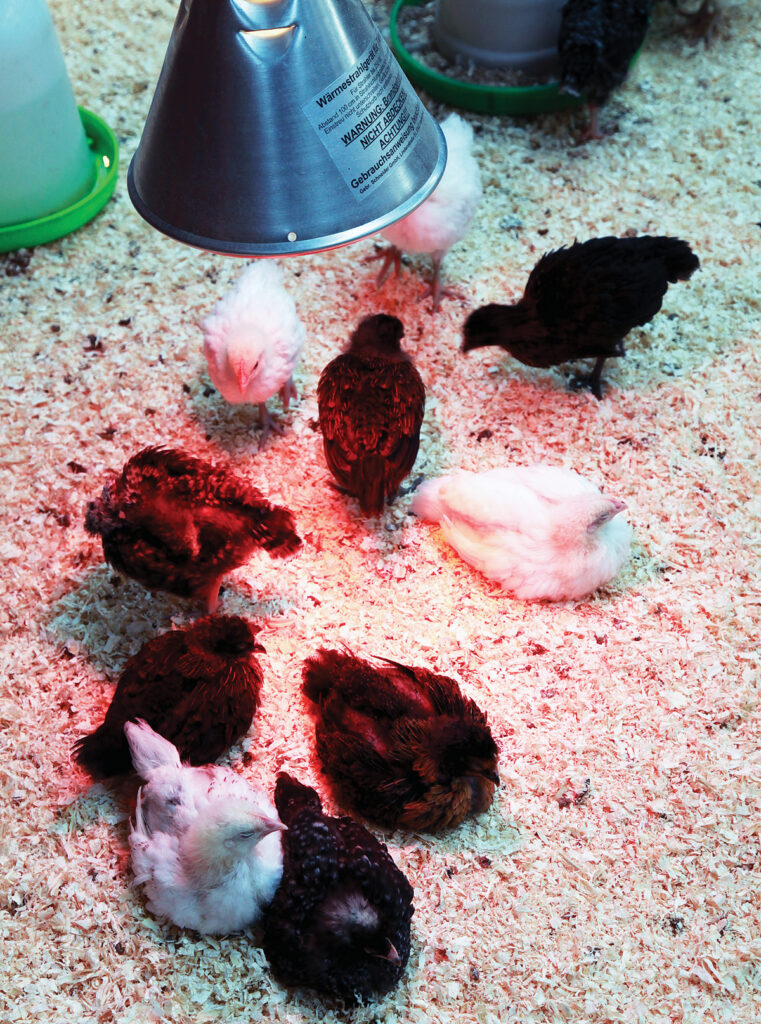
Find the best chick brooder heater for your brooder to keep baby chicks warm while reducing the fire hazard that comes along with heat lamps.
The use of heat lamps when brooding chickens is a topic of intense debate. The large, red bulbs housed in metal were once popular but are now falling out of favor. The high risk of fires is especially concerning, and there are several reports of barns or homes lost to heat lamps each winter. It’s important to note that not all of these incidents have been in brooders — they may also result from people who choose to heat their coops.
One way to minimize the danger of heat lamps is to ensure you have the correct lamp for your bulbs. Many of the popular red bulbs are 250-watt bulbs. However, clamp lights can be found that look very similar to brooder lamps but will only hold a 150-watt bulb. These lamps can look identical but are intended as work lamps with lower-wattage bulbs. Mistakenly using one of these clamp lamps with a 250-watt bulb can result in the bulb exploding. This results in dead chicks from the explosion or from eating the glass, and exploding bulbs can start fires in the brooder or coop.
There are other reasons to avoid heat lamps, revolving around the need for the brooder to be constantly lit to provide heat. Studies have compared artificially raised to natural brooding chicks with various light and heat sources. Most of the research on how constant light affects chick development focuses on industrial setups, but there’s still insight for the small flock owner.
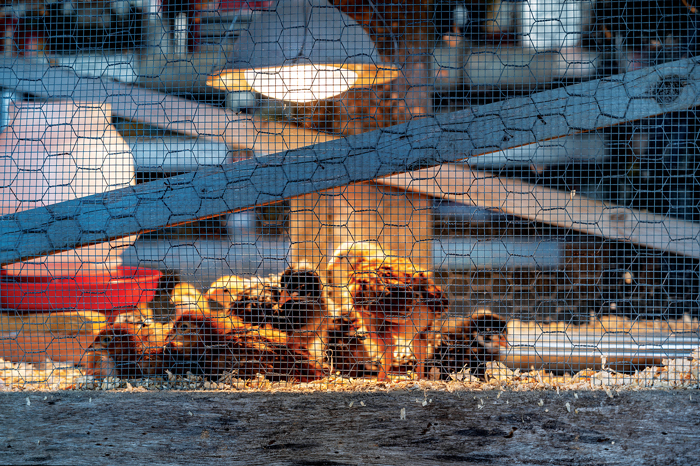
One study compared chicks raised under constant, red lighting to chicks brooded by a hen. Chicks raised by a hen were more active and had less neurotic, feather-pecking behaviors than those under a light. Another study showed that brooded chicks forage more than chicks raised by other methods. Chick behavior in different light conditions was recorded and researchers found that the birds in the dim lighting showed less activity overall.
The development of the eye structure depends on lighting as well. Chicks who experience fluctuations in light levels, just as they would in an outdoor environment, develop larger eyes. Even brief exposure to light during the “dark” cycle has been shown to change eye development. A 2004 study by Liu, Pendrak, Capehart, et al. concluded, “Dim-light rearing influences the chick eye compared to either the light-dark or constant light conditions.” This shows that the lighting chicks are raised under makes a difference in their development.
Separating the need for heat from light will help ensure chicks can develop normally. Chick heating pads and heat plates have become popular in recent years. However, the pads can become filthy very quickly, and the plates require extra accessories to prevent older chicks from perching and pooping on them. They’re also more expensive than heat lamps and are limited in how many chicks they can keep warm.
Some less common methods of keeping chickens warm can depend on climate, time of year, and available time. Hot water bottles, “cold brooding,” and wood stoves have been used historically and are still used by those living off the grid.
Hot water bottles are flat, rubber containers that hold hot water to soothe aches and pains. They’re the heating pads of old and are insulated to retain heat; however, they do cool off over time. So, while they may provide a comfy, fire-proof way of brooding chicks, someone needs plenty of spare time to boil water and swap them out in the brooder.

For those living off-grid, “cold brooding” chicks may be considered if the hatching is done later in the year. Sometimes, this is done in conjunction with hot water bottles. However, this provides little opportunity for the chicks to move about. Additionally, in colder climates, higher fatalities are expected. One early study showed a higher mortality rate even when cold brooding is around 80 degrees Fahrenheit.
Diverse environments, setups, and lifestyles will require different methods. Luckily, chickens have been domesticated for far longer than we’ve had heat lamps or electricity. Less than a century ago, the U.S. government still sent flyers telling people how to brood chicks with coal and gas stoves! Nowadays, advancements give chicken breeders several options to choose from.
Whatever you choose, please take proper precautions and be safe.
References
Debora L. Nickla, Kristen Totonelly, Brief light exposure at night disrupts the circadian rhythms in eye growth and choroidal thickness in chicks, Experimental Eye Research, Volume 146, 2016, Pages 189-195, ISSN 0014-4835, https://doi.org/10.1016/j. exer.2016.03.003 R.A. Blatchford, G.S. Erskin, Ralph. Livestock for Small Farms. Farmer’s Bulletin No. 1753. U.S. Department of Agriculture: 1942. G.M. RENWICK, K.W. WASHBURN, G.M. LANZA, Genetic Variability in Growth Response of Chicks to Cold Brooding Temperature, Poultry Science, Volume 64, Issue 5, 1985, Pages 785-788, ISSN 0032-5791, https://doi.org/10.3382/ps.0640785. R.A. Blatchford, Archer, J.A. Mench, Contrast in light intensity, rather than day length, influences the behavior and health of broiler chickens, Poultry Science, Volume 91, Issue 8, 2012, Pages 1768-1774, ISSN 0032-5791, https://doi.org/10.3382/ps.2011-02051 3, 7 R.A. Blatchford, K.C. Klasing, H.L. Shivaprasad, P.S. Wakenell, G.S. Archer, J.A. Mench, The effect of light intensity on the behavior, eye and leg health, and immune function of broiler chickens, Poultry Science, Volume 88, Issue 1, 2009, Pages 20-28, ISSN 0032- 5791, https://doi.org/10.3382/ps.2008-00177 Riber, A.B.; Guzman, D.A. Effects of Dark Brooders on Behavior and Fearfulness in Layers. Animals 2016, 6, 3. https://doi.org/10.3390/ani6010003 Ji Liu, Klara Pendrak, Cheryl Capehart, Reiko Sugimoto, Gregor F. Schmid, Richard A. Stone, Emmetropisation under continuous but non-constant light in chicks, Experimental Eye Research, Volume 79, Issue 5, 2004, Pages 719-728, ISSN 0014- 4835, https://doi.org/10.1016/j.exer.2004.08.007 Tsuyoshi Shimmura, Eriko Kamimura, Toshihide Azuma, Norio Kansaku, Katsuji Uetake, Toshio Tanaka, Effect of broody hens on behaviour of chicks, Applied Animal Behaviour Science, Volume 126, Issues 3–4, 2010, Pages 125-133, ISSN 0168-1591, https://doi.org/10.1016/j.applanim.2010.06.011.
Sherri Talbot is the co-owner and operator of Saffron and Honey Homestead in Windsor, Maine. She raises endangered, heritage-breed livestock and hopes someday to make education and writing on conservation breeding her full-time job. Details can be found at Saffron and Honey Homestead or on Facebook.
Originally published in the December 2024/January 2025 issue of Backyard Poultry and regularly vetted for accuracy.
…
backyardpoultry.iamcountryside.com
Feed Name : Backyard Poultry
Feed & Health,brooder,chick-brooder
hashtags : #Chick #Brooder #Heater #Backyard #Poultry








Leave A Comment