
What Should You Consider When Building a Chicken Coop?
Building a chicken coop well means thinking through size, materials, ventilation, accessibility, run space, predator protection, climate, water and feed setup, bedding, and cost before you start cutting wood. Get these right, and you’ll have a coop that keeps your flock comfortable, healthy, and productive for years.
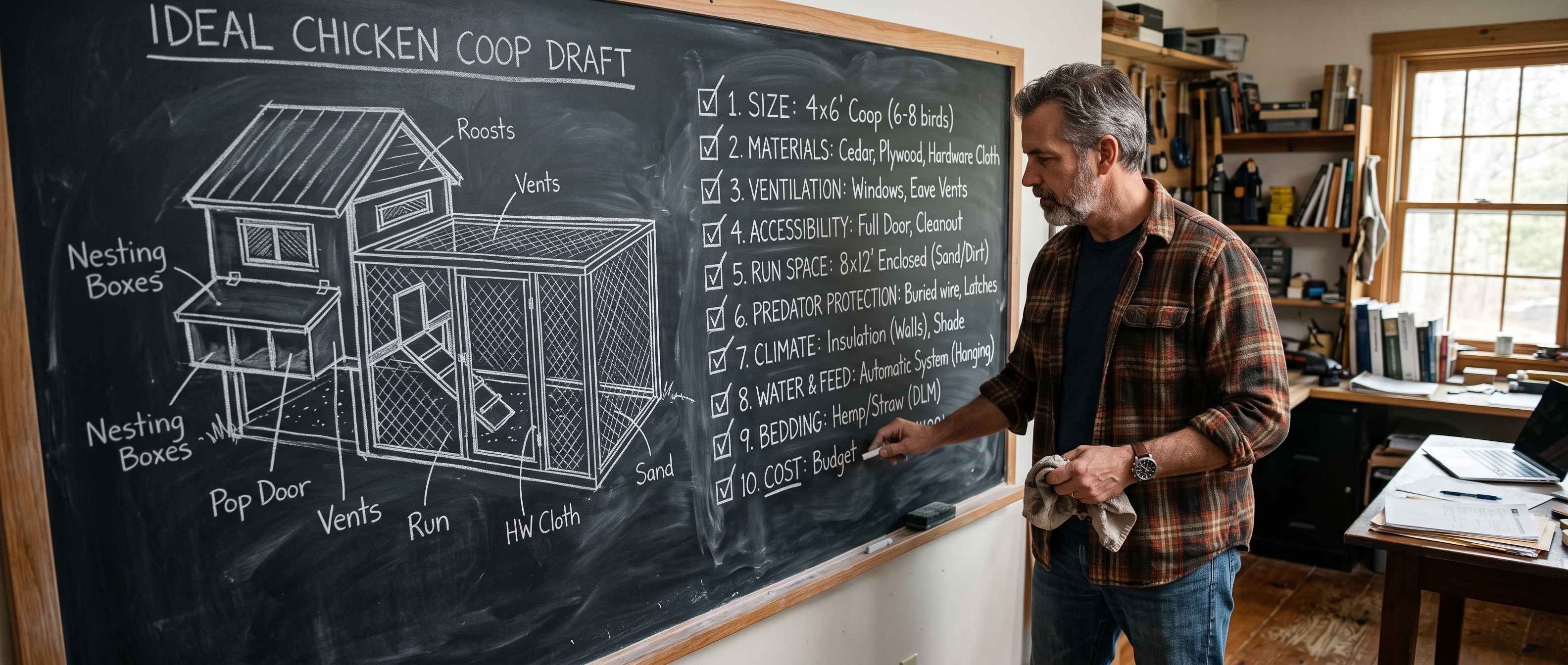
Building a chicken coop is simpler than building a house, but it’s no less important to your chickens than your house is to you. With that in mind, here are 10 things worth considering before you start pounding nails or driving screws, which is what I actually use for everything I build these days.
These aren’t ranked in order of importance. I just think all 10 deserve serious consideration if you want your chickens to be as comfortable and productive as possible.
Table of Contents
1. Size
Think about how many chickens you have and make sure the coop gives them room to move freely. Overcrowding causes real problems: excessive pecking and feather picking, occasional cannibalism if the chicken-to-space ratio gets out of hand, fighting, a filthier coop, toppled feeders and waterers, and a faster spread of illnesses and parasites like lice and mites when birds are packed too tightly.
At the same time, you don’t want so much space that your birds struggle to stay warm together in winter. For overall comfort, aim for about 4 square feet per chicken. Less for bantams, more for larger breeds like Jersey Giants.
2. Coop Materials
Wood, plastic, or metal — it doesn’t matter as long as it’s durable enough to handle wind, rain, snow, hail, and predators.
Wood is the obvious favorite for durability, ease of building, and honestly, looks. Redwood and cedar resist rot and insects well. Treated lumber holds up too, but the chemicals in it aren’t good for your birds.
Metal is tough, but it gets brutally hot in summer and just as cold in winter, so insulation becomes essential if you go that route.
Plastic checks a lot of boxes: it’s light, easy to clean, and termites and powder post beetles won’t touch it. Its downside is durability, and it’s not pleasant to work with or repair. In the end, it comes down to what fits your situation.
3. Ventilation
Chicken droppings emit ammonia gas, which irritates the skin, eyes, mouth, throat, and lungs, and, at high enough concentrations, can cause serious lung damage or worse. It’s hard to get eggs from a sick flock, just saying.
Aim for two or three vent ports, positioned up near the peak since heat and ammonia both rise. Every vent needs to be predator-proof too. Sturdy metal cloth over each one does the job. Remember, a mink can squeeze through a hole the size of a quarter.
4. Accessibility
Good accessibility matters for you and for your chickens. You’ll need to get in regularly to gather eggs and to clean, and neither should feel like a chore in itself. Nobody enjoys bumping their head every trip out to the wheelbarrow with a shovelful of bedding.
You’ll also want enough room for a proper wall-to-wall roost, or two or three, along with space for nesting boxes. All of that points to one conclusion: build in a real, human-sized door.
5. Run Area
Chickens love being outside. If free-ranging isn’t an option for you, a run is the next best thing, and it has one real advantage over free-ranging: it keeps your flock safer from predators, as long as it’s built right.
Give your birds about 10 square feet of run space. They’ll peck, scratch, dig dust bath holes, and stretch their wings, so more space is always better.
Run walls need to be sturdy enough to stop predators. My rule of thumb is if it’ll stop a dog, it’ll stop almost anything else short of a bear, and fencing should be buried at least 6 inches deep to stop digging. You can’t stop a bear completely, but you can slow it down long enough to scare it off.
The top of the run needs protection from aerial predators too. Wire holds up far better than fabric netting for that job. Add shade with tarps or by building under a shade tree, and toss in a few things for the chickens to interact with: perches, logs, cardboard boxes, hay bales, plastic balls. Food and water should be available in the run at all times, same as inside the coop.
6. Predators
Let’s be honest, chickens are on nearly every predator’s menu. Daytime threats include hawks and eagles, foxes raising kits, domestic cats, mink and weasels, snakes, and bears. At night, you’re dealing with foxes, coyotes, raccoons, mink, weasels, opossums, fishers, skunks, bears, and, around dusk, the occasional owl.
Look for sturdy latches, secure doors, and predator-proof mesh when you’re planning your build. I run a motion-activated solar light on my own coop. It won’t scare off everything, but it does a decent job of deterring some predators, and at a minimum it alerts me that something’s out there. trick can help scare off some animals, but not all of them. What it does do is alert me that something is outside of my coop.
7. Building With Climate in Mind
Your materials should reflect your actual climate. Keeping birds warm in winter and cool in summer isn’t optional. The way a coop is built can genuinely be the difference between life and death for your flock.
Insulation helps trap or block heat in either direction, but whatever type you use — spray foam, fiberglass, foam board — it needs to be covered. Chickens will eat exposed insulation given the chance. They just don’t know better.
I learned this one firsthand: I had a half sheet of foam board glued to the side of my garage to protect the wall from a swinging car door, and my chickens wouldn’t leave it alone. I ended up taking it down. Smooth sheeting, plastic panels, wood paneling, or painted plywood all work well as a cover, and smooth surfaces are also easier to keep free of mite and lice infestations, and easier to clean in general.
Just don’t build the coop too airtight in the process. Ventilation still has to come first.
8. Water and Feed Setup
Where you place feeders and waterers, and how many you run, matters as much as the coop structure itself. A chicken drinks about a pint of water daily, more in hot weather, so plan on enough waterers for your flock size rather than just one and hoping it’s enough.
Trough-style waterers should sit around upper breast height so birds can scoop easily, and elevated feeders help keep bedding and droppings out of the feed. If you’re running nipple waterers instead, mount them at a height comfortable for your smallest bird, since taller setups can leave younger or smaller chickens struggling to reach.
Plan for easy refilling too. A feeder or waterer that’s a hassle to access won’t get refilled as often as it should.
9. Bedding
Bedding affects cleanliness, odor control, moisture management, and honestly, how much your chickens enjoy their space. Pine shavings and straw are common choices, both absorbent and reasonably priced. Avoid cedar shavings. The oils in cedar can irritate a chicken’s respiratory system over time.
Keep at least 4 inches of bedding down for good insulation and absorption, and plan your cleaning schedule around your flock size and coop ventilation. Some keepers use the deep litter method, letting bedding build up and break down naturally over months, which works well if you manage the moisture level. Others prefer regular full cleanouts. Either approach is fine as long as ammonia buildup stays under control.
10. Cost
Your budget shapes how elaborate your coop gets. A basic 10-by-10-foot box is perfectly functional as far as the chickens are concerned, but some keepers go further with weather vanes, solar heating, heated perches, or thermal windows.
Aesthetics come down to personal taste. I’ve seen coops built as mini replicas of the owner’s house, and others that barely qualify as structures at all. Whatever you build, just build it in a way that doesn’t break the bank.
Building your own coop is a genuinely satisfying project. You get to build it exactly the way you and your flock need it.
FAQ
How much space does a chicken need in a coop?
About 4 square feet per bird inside the coop, plus roughly 10 square feet per bird in an attached run, adjusted up or down depending on breed size.
What’s the best material for a chicken coop?
Wood is the most popular choice for durability and workability, with cedar or redwood offering natural rot and insect resistance. Metal and plastic both work too, each with their own tradeoffs around temperature control and long-term durability.
Do chickens really eat insulation?
Yes, if it’s exposed. Cover any spray foam, fiberglass, or foam board with smooth sheeting, plastic panels, or painted plywood to keep your birds from pecking at it.
How often should coop bedding be changed?
It depends on your method. A deep litter approach can go months between full cleanouts if managed well, while more frequent spot cleaning and periodic full changes work better for smaller setups. Either way, keep an eye on ammonia smell as your signal to clean.
I hope this information has been helpful. If it has, please leave me a message below to let me know.
…
chickenmethod.com
Feed Name : Chicken Method
Coops & Equipment
hashtags : #Building #Plans #Chicken #Coop #Considerations










Leave A Comment