
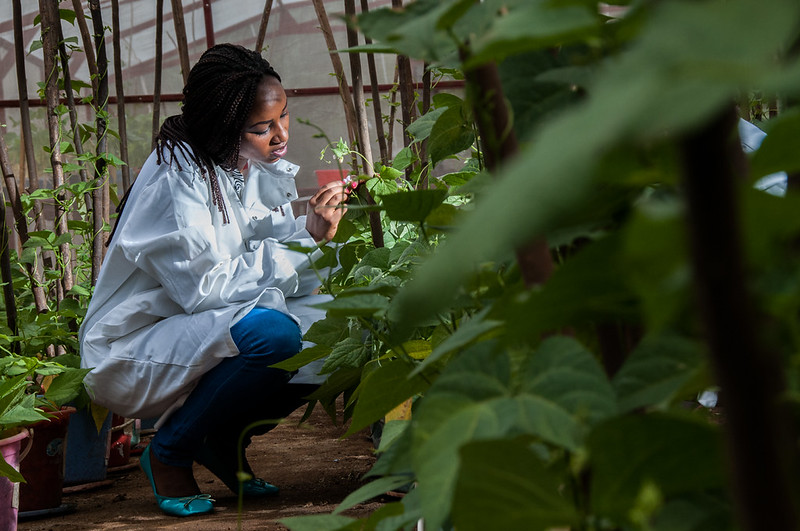
I grew up on a farm, and as a child I was given my own small piece of land. I turned it into a flower garden. My goal was simple: as much colour as possible. I collected seeds in old candy boxes and became fascinated by how plants could produce such an extraordinary variety of shapes.
Years later, a science teacher, who happened to be a woman, explained that changes in a plant’s DNA were what produced the differences I’d been drawn to as a child, the same principle behind Mendel’s pea experiments generations earlier. That was the moment a whole field of science, one built around questions I’d been asking without knowing their name, came into focus. I was determined to go into plant biotechnology from that point.
That is one reason the International Year of the Woman Farmer feels meaningful to me. I like that we are being asked to pause on this for a year, not merely a day. There is a lot to say about the role women play in producing our food, and also about how disconnected many of us have become from everything that happens before food reaches our plate.
The scale of women’s contribution is easy to underestimate. FAO’s latest data show that 76 per cent of working women in sub-Saharan Africa are employed in agrifood systems.¹ Yet women still face persistent gaps in access to land, finance, technology, education and services. The organisation estimates that closing productivity and wage gaps in the region could add around $53 billion to GDP and reduce food insecurity.¹ Those numbers make the case for action, but they also remind us that this is not simply a question of recognition. It is about whether women have the tools and opportunities to do what they are already doing on fairer terms.
Crop science has a key role to play here. Genetics cannot change the climatic conditions a farmer is exposed to, but it can widen the margin she has to work with.
Much of my own research looks at how plants cope with drought and heat. The challenge is not simply to identify genes that are involved, but to understand how to fine-tune them. If we can identify the precise regulatory switches behind resilience, rather than relying on broad interventions, breeders have a better chance of building climate resilience into crops without trading it off against yield or local adaptation.
That last point matters. A technically impressive plant is not necessarily a useful crop.
I have worked on transferring genome-editing technology into tropical maize, and it made that concrete for me. A gene edit that improves drought tolerance in a controlled trial is not automatically a variety that a farmer will plant, save seed from and trust through an unpredictable season. The trait you target, the variety you start with and even the way a technology is delivered all have to reflect the realities of the people growing it. In many regions, those day-to-day decisions are being made by women, often with less access to inputs, extension services or secure land tenure.
Plant science still has one of its biggest hurdles here. New spatial and single-cell technologies allow us to observe, almost cell by cell, how a plant responds to its environment or commits to a new developmental fate. We can see more than we ever could before; the challenge now is translating that into something breeders can use.
Most plant biotechnology research has historically taken place in greenhouses, while crops grow in fields. Finding the “translation key” between those two environments is something I care deeply about. Curiosity-driven research is enormously valuable, but I have always believed it becomes even more powerful when we test it against application. Can what we learn about a regulatory network actually help a breeder? Can it work in a locally adapted variety? Will it hold up when the plant faces heat, drought and the other stresses of a real field?
Getting from possibility to real-world impact depends not only on good science, but on giving people the freedom and opportunity to pursue ideas that may lead somewhere unexpected.
I strongly believe in serendipity, in being open enough to recognise an unexpected opportunity and having the resilience to act on it. But opportunity cannot depend on serendipity alone. If we want more young women to build farms, research programmes, breeding programmes or agricultural businesses, encouragement is not enough. Education and mindset matter, but so do funding, access, entrepreneurship and the freedom to try something new.
What matters now is what this year leaves behind. The International Year of the Woman Farmer should translate into programmes, investment and partnerships that give women a stronger role in shaping how food is produced and how agricultural innovation is developed.
Let it be more than awareness. Make it count.
Sources:
Food and Agriculture Organization of the United Nations, The Status of Women in Agrifood Systems in Sub-Saharan Africa, 2026.
Banner photo credit: CIAT
…
https://farmingfirst.org/2026/10/making-this-international-year-of-the-woman-farmer-count/
farmingfirst.org
Feed Name : Farming First
Gender,gender,gene editing,IYWF
hashtags : #Making #International #Year #Woman #Farmer #count




Leave A Comment