
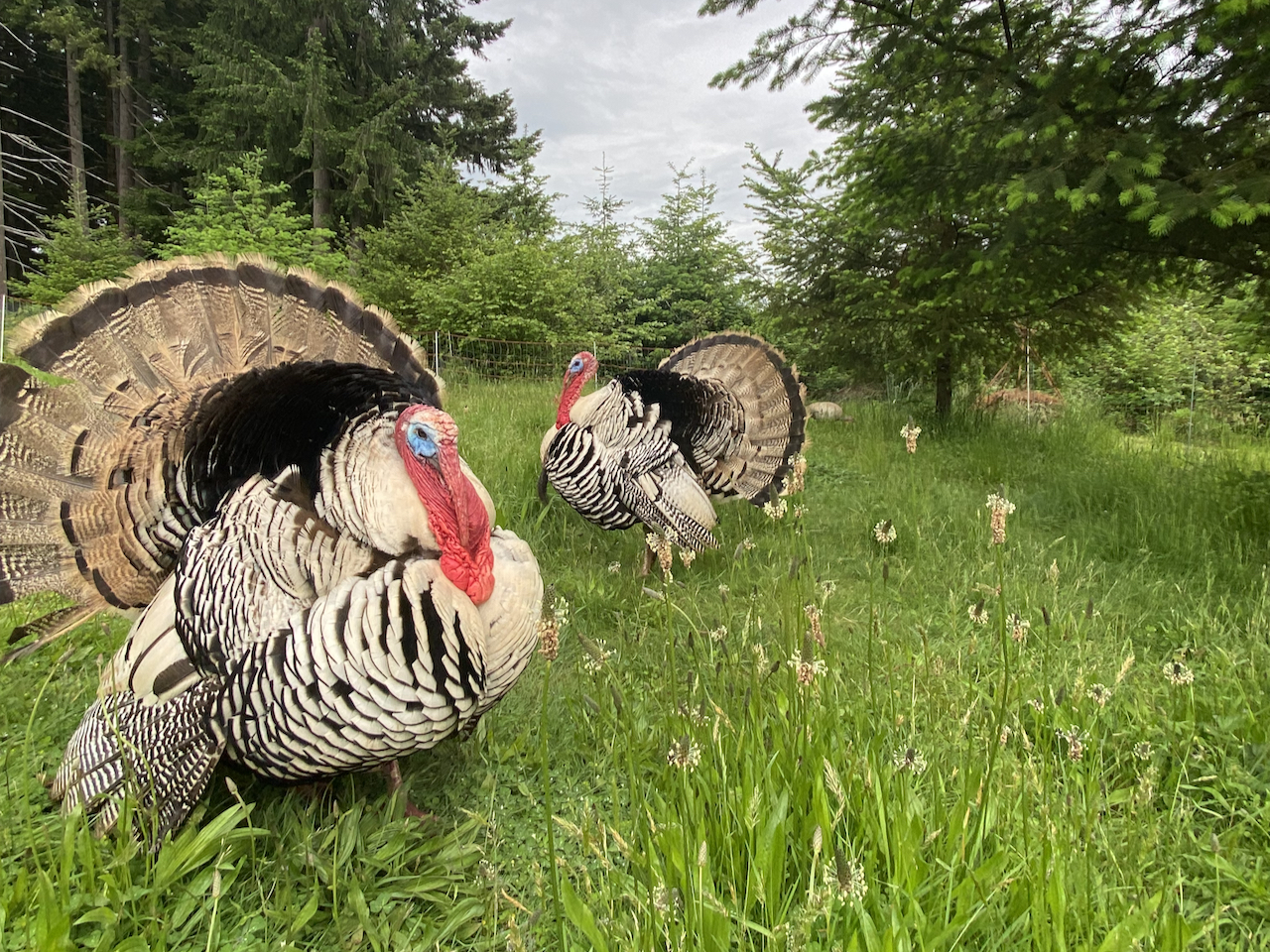
Raising Heritage vs. Production Turkeys
One reason to raise Heritage turkeys instead of production varieties is that raising Heritage turkeys gives you more options. There are some important differences to be aware of between Heritage and production turkeys. Heritage turkeys have a slower rate of growth, are capable of natural reproduction, and can live long productive lives. Production turkeys, by contrast, grow quickly, cannot reproduce naturally, and tend to have short lives as a result of their large size.
If you want to raise a self-sustaining flock of turkeys and are also interested in keeping a few year-round, Heritage turkeys are the way to go. Seeing how well-adapted turkeys are to their natural environment through the seasons—nesting and laying eggs in the tall grass in the spring, raising little ones in the summer, and withstanding cold winters and snow like champs—is truly a wonderful part of the turkey experience.
Raising Turkeys for the Table
Production turkeys have an excellent feed conversion ratio, meaning they are efficient at turning food into body weight. Broad-breasted production varieties can weigh as much as 50 pounds at maturity, which is achieved in four to five months. By comparison, Heritage turkeys typically grow to a mature size of 20 to 25 pounds in six to seven months. The better feed conversion ratio of production turkeys compared to Heritage turkeys may be a consideration for those looking to raise turkeys on a larger scale or as a profitable endeavor. However, feed conversion is not the only factor to consider. If you want to keep turkeys for a longer time beyond maturity, Heritage turkeys have the advantage of growing to a healthier weight, and, as a result, have a much longer lifespan.
Foraging Experts
Turkeys are excellent foragers, and they can find much of their daily intake on their own, although they will still need to be provided with a well-balanced feed to make certain they are meeting their nutritional requirements. When allowed to free-range or given access to a productive pasture, turkeys can forage for approximately 50% of their diet from spring through fall. If your objective is to raise turkeys for the table, it is important to provide high-quality feed to supplement their foraging to get them up to weight in a reasonable period.
…
blog.mcmurrayhatchery.com
Feed Name : Murray McMurray Hatchery Blog
Featured,Guest Articles,Heritage Breeds,Stacy Benjamin,Turkeys
hashtags : #Expect #Raising #Turkeys










Leave A Comment